AI Leaders Keep Moving the Goalposts on AGI
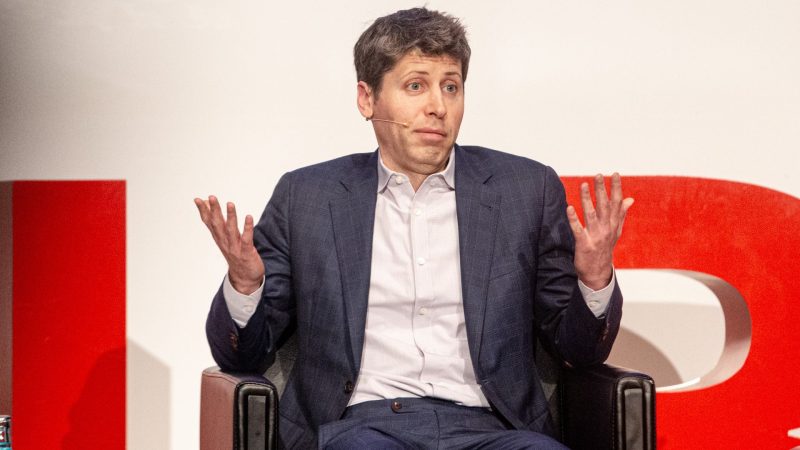
AI executives have spent years predicting AGI is just around the corner, and a new running log tracks their most absurd, contradictory quotes and trendy buzzwords.
Ever notice how the people getting rich off AI keep telling us it might end the world — right before asking for more data centers? Yeah, us too.
That's the vibe behind a new running tally of the most ridiculous things AI bigwigs have said. The premise is simple: the leaders of the AI era love watching their valuations climb almost as much as they love warning us their software could destroy everything. AI is going to kill us all — now can we get more money for data centers, please?
Their other favorite hobby? Inventing trendy phrases that either explain how smart the next model will be or justify why last year's promised sentience never showed up. These buzzwords are hard to track and even harder to parse, so the log exists to remind us how often AI thought leaders contradict each other and move the goalposts.
The AGI predictions alone are a trip. Back in October 2023, Google's Blaise Agüera y Arcas and Stanford's Peter Norvig declared AGI was already here. By March 2024, Nvidia's Jensen Huang said we'd get there within five years, while Elon Musk figured it was one to two years away. A month later, Musk doubled down on 2025. OpenAI's Sam Altman agreed, saying AGI was coming in 2025.
Then the timelines started slipping. In January 2025, Google's Demis Hassabis guessed three to five years. By December 2025, Musk was saying xAI could hit AGI in the next few years, maybe 2026. August 2026 brought Altman saying OpenAI was "not quite yet" there, but that an internal system he'd call AGI would arrive by year's end. And in September 2026, Huang posted that GPT-6 Astra meant AGI had officially arrived.
When AGI stopped being convenient, the industry found a new promised land: recursive self-improvement. Anthropic's post "When AI builds itself" pushed the term into overdrive, describing a future where AI autonomously designs its own successor — while noting we're not there yet and it isn't inevitable. There's also "pace the frontier," a phrase that surfaced after 1,386 frontier AI employees signed a statement asking the U.S. government to help deliberately slow automated AI development.
So what's the takeaway for you? Mostly that the people selling AI keep rewriting the finish line, and the buzzwords change faster than the models do. Worth keeping an eye on — and maybe a grain of salt handy. What do you think: are these predictions bold vision or just good marketing?
📰 Related Articles
What BioWare's Closure Reveals About Game Industry Leadershi…
Zeschuk's comments highlight a growing rift between game developers and business executives, especially as closures and AI cuts continue—players may see more studios shuttered by leaders who lack hand…
What New Leadership Means for Dragonlance and D&D on Screen
For players, this means the door isn't fully closed on a live-action Dragonlance adaptation, and a D&D documentary could also see the light of day. It signals that new leadership at Wizards of the Coa…
What Helen Chiang's Quick Exit Means for Xbox Leadership
A three-month tenure for a top Xbox executive signals notable leadership churn, though the immediate effect on players and Xbox's strategy is not yet known.
What Cartography, Leadership & Stealth Mean for Stars Reach…
The update broadens playstyle options in Stars Reach, giving solo stealth players and group-focused leaders distinct new progression paths to invest in.
What 101 Studio Leaders Reveal About AI in Game Dev
The data suggests AI is nearly universal in studios but still mostly experimental, meaning players shouldn't assume games are being built with deeply integrated AI workflows just yet.
What CK3 Teaches Us About Removing a Bad Leader
This humorous experiment shows how CK3's emergent gameplay can mirror real political chaos, making it a great tool for understanding power struggles—and laughing at them.